











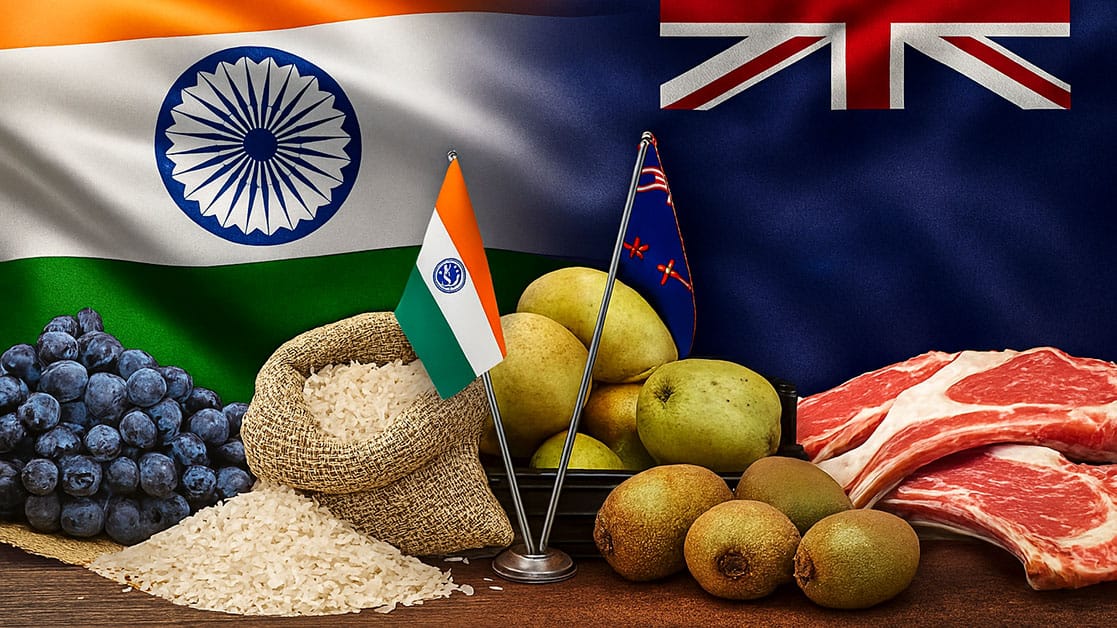
New Delhi, October 29, 2025 — Commerce and Industry Minister Piyush Goyal announced his upcoming visit to New Zealand next week to advance negotiations on the proposed India–New Zealand Free Trade Agreement (FTA). The announcement comes amid growing momentum in bilateral trade, which reached USD 1.3 billion in 2024–25, marking a 49% year-on-year growth. The FTA, formally launched on March 16, 2025, is expected to unlock new opportunities in goods, services, investment, and agricultural cooperation between the two nations.
India and New Zealand first initiated discussions on a Comprehensive Economic Cooperation Agreement (CECA) in April 2010. After nine rounds of negotiations, talks stalled in 2015 due to differences over market access and regulatory alignment. The renewed push in 2025 reflects a strategic recalibration by both governments, driven by shifting global trade dynamics and the need for resilient supply chains.
The third round of negotiations concluded on September 19 in Queenstown, New Zealand, with both sides expressing optimism about reaching a “substantially close” agreement. Minister Goyal’s visit is expected to finalize key provisions related to tariff elimination, investment facilitation, and regulatory harmonization.
New Zealand’s average import tariff stands at just 2.3%, making it an attractive market for Indian exporters. The FTA aims to reduce barriers further, especially in sectors where India has a competitive edge—textiles, pharmaceuticals, engineering goods, and agri-machinery.
India’s export basket to New Zealand is diverse, ranging from clothing and home textiles to refined petroleum, pharmaceuticals, and agricultural equipment. In recent years, demand for Indian tractors, irrigation tools, and processed food products has grown steadily in New Zealand’s rural and semi-urban markets.
Conversely, New Zealand’s exports to India are dominated by agricultural commodities—apples, kiwifruit, lamb, mutton, dairy derivatives like milk albumin and lactose syrup, and minerals such as coking coal and timber. The FTA is expected to streamline import procedures and reduce costs for Indian buyers, particularly in the food processing and construction sectors.
Experts believe the agreement will also promote investment linkages, allowing New Zealand firms to participate in India’s agri-tech and clean energy sectors. Joint ventures in dairy processing, cold chain logistics, and horticulture could benefit both economies.
India–New Zealand Bilateral Trade Snapshot
| Category | India’s Exports to NZ (2024–25) | NZ’s Exports to India (2024–25) |
|---|---|---|
| Textiles & Apparel | $210 million | $12 million |
| Pharmaceuticals & Medical Supplies | $150 million | $8 million |
| Agri-Machinery & Equipment | $95 million | $5 million |
| Petroleum Products | $180 million | $0 |
| Food & Agricultural Commodities | $60 million | $320 million |
| Minerals & Timber | $15 million | $280 million |
Trade policy analyst Dr. Meera Subramanian from the Indian Council for Research on International Economic Relations (ICRIER) noted, “The India–New Zealand FTA is strategically important. It diversifies India’s trade portfolio and strengthens our presence in the Pacific region. For agriculture, it opens up access to high-quality inputs and technologies.”
New Zealand’s Trade Minister Todd McClay emphasized the mutual benefits of the deal. “India is a priority partner for us. We see immense potential in collaborating on food security, sustainable farming, and digital trade. The FTA will provide a predictable framework for businesses and investors,” he said during a press briefing in Wellington.
Industry leaders in India are also optimistic. Rajesh Agarwal, CEO of Bharat AgroTech, said, “We’ve already seen rising demand for Indian irrigation systems and tractors in New Zealand. With reduced tariffs and simplified logistics, we expect exports to double in the next two years.”
If concluded successfully, the India–New Zealand FTA could serve as a template for future agreements with other Pacific nations. It aligns with India’s broader Indo-Pacific strategy and complements existing FTAs with ASEAN, Australia, and the UK.
Challenges remain, particularly around non-tariff barriers, sanitary and phytosanitary standards, and digital trade regulations. India will need to ensure that its exporters are equipped to meet New Zealand’s stringent quality and sustainability norms.
On the domestic front, the Indian government is expected to roll out support measures for MSMEs, including export facilitation centers, digital documentation platforms, and sector-specific incentives. These steps will be crucial in ensuring that smaller players can benefit from the agreement.
New Zealand, meanwhile, is likely to push for greater access to India’s dairy and meat markets—sectors that have traditionally been sensitive due to domestic political and cultural considerations. Negotiators will need to strike a balance that protects local interests while enabling trade expansion.
The India–New Zealand Free Trade Agreement represents a significant step forward in bilateral economic relations. With negotiations nearing completion, both countries stand to gain from enhanced market access, diversified supply chains, and deeper investment ties. For Indian exporters—especially in agriculture, textiles, and pharmaceuticals—the deal offers a gateway to a stable, high-value market.
As Minister Goyal prepares for his visit, stakeholders across sectors are watching closely. The outcome of these talks could redefine India’s trade engagement with the Pacific and set the tone for a new era of cooperation rooted in mutual growth and resilience.