









ILO Report
On September 25, 2025, the International Labour Organization (ILO) released its landmark report titled “The State of Social Justice: A Work in Progress”, marking 30 years since the historic 1995 Copenhagen Summit on Social Development. The 177-page report offers a sweeping evaluation of global progress in social justice, highlighting major achievements in poverty reduction, education, and child labor—but also sounding the alarm on persistent inequality, fragile trust in institutions, and the urgent need for coordinated action.
Key Achievements Since 1995
Despite global turbulence, the report documents several transformative gains:
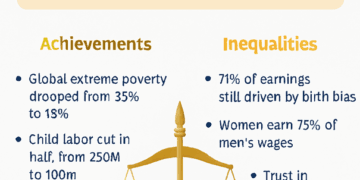
- Extreme Poverty: Dropped from 39% to 10% of the global population
- Child Labor: Halved from 250 million to 106 million (ages 5–14)
- Primary School Completion: Increased by 10 percentage points globally
- Social Protection: Over 50% of the world now covered by some form of pension, insurance, or welfare
- Labour Productivity: Rose 78% globally; 215% in upper-middle-income countries
ILO Director-General Gilbert F. Houngbo emphasized that these gains reflect the power of coordinated international policy and the resilience of global institutions. “The world is wealthier, healthier, and better educated than it was in 1995,” he said. “But progress has not been evenly shared.”
Persistent Inequality and Structural Barriers
Despite the gains, the report reveals stark and stubborn deficits:
- Birth Bias: 71% of a person’s earnings are still determined by country and gender
- Informal Employment: Affects 58% of global workforce, with little change in two decades
- Gender Participation Gap: Narrowed by just 3% since 2005; remains at 24%
- Gender Pay Gap: Women earn 78% of men’s wages; may take a century to close
- Trust in Institutions: Declining since 1982, especially in democracies
The report warns that these inequalities are not just economic—they threaten the legitimacy of democratic systems and global cooperation. “Social justice is not only a moral imperative,” Houngbo said. “It is essential for economic security, social cohesion, and peace.”
Three Global Transitions Reshaping Justice
The ILO identifies three major transitions that will define the future of work and justice:
- Environmental Transition: Climate change and shift to green economies
- Digital Transition: Automation, AI, and platform-based work
- Demographic Transition: Aging populations in high-income countries; youth bulge in low-income regions
These transitions are creating new jobs and destroying old ones. Without deliberate policies, they risk deepening existing divides. The report calls for “fair transitions” that include reskilling, social protection, and inclusive governance.
Climate and Employment: A Double-Edged Sword
Climate change is already reshaping labor markets. The report estimates:
- 6 million jobs may be lost in fossil fuel industries
- 24 million jobs could be created in renewable energy and green sectors
- 70 million workers will require reskilling by 2030
Low-income earners, who contribute just 12% of global emissions, will bear 75% of income losses from climate-related effects. The ILO urges governments to adopt “just transition” frameworks that promote decent work, reduce inequality, and involve social dialogue.
Digital Divide and Platform Work
Digital transformation has accelerated post-pandemic, but its benefits remain uneven. Platform-based gig work has expanded, yet most workers lack formal protections. The report highlights:
- Only 18% of gig workers have access to health insurance or pensions
- Algorithmic bias and opaque rating systems affect income and job security
- Digital literacy gaps persist across age, gender, and geography
ILO recommends regulating platform work, ensuring transparency in algorithms, and expanding digital skills training.
Demographic Shifts and Migration
Between 2030 and 2050:
- Labour force in high-income countries will shrink by 5%
- Low-income countries will see 30% growth in working-age population
This imbalance will drive migration and reshape global labor markets. The report calls for inclusive migration policies and regional cooperation to manage demographic transitions fairly.
Social Protection and Decent Work
While social protection coverage has expanded, gaps remain:
- 800 million people still live on less than $3/day
- 1 in 4 lacks access to safely managed drinking water
- Scores on freedom of association and collective bargaining rights have deteriorated
ILO urges countries to invest in universal social protection floors, fair wage systems, and active labor market policies.
Trust Deficit and Institutional Fragility
The report reveals a widespread crisis of trust:
- Confidence in governments, unions, and businesses has declined globally
- Perceptions of unfair reward systems are rising
- Social dialogue is weakening in many democracies
Houngbo warns that without renewed social contracts, democratic legitimacy may erode. “We must rebuild trust through inclusive governance, transparency, and accountability,” he said.
Call to Action: Bold and Coordinated Policies
The ILO calls for a new global compact for social justice, anchored in:
- Human Rights: Equal access to opportunity and dignity at work
- Fair Distribution: Equitable sharing of economic gains
- Fair Transitions: Managing climate, digital, and demographic shifts inclusively
- Social Dialogue: Empowering workers, employers, and institutions
“Incremental reforms will not suffice,” Houngbo said. “We need bold, coordinated action.”
Upcoming World Summit in Doha
The findings will shape discussions at the Second World Summit for Social Development in Doha, Qatar, scheduled for November 2025. The summit will bring together governments, international institutions, and civil society to chart a path toward inclusive, resilient societies.
Conclusion: Justice as the Foundation of Progress
The ILO’s 2025 report is both a celebration of progress and a sobering reminder of the work ahead. While poverty and child labor have declined, inequality, informality, and institutional fragility persist. As the world navigates climate, digital, and demographic transitions, social justice must be placed at the heart of policymaking. Only then can we build economies that are not just productive—but fair, inclusive, and sustainable.




Comments 1