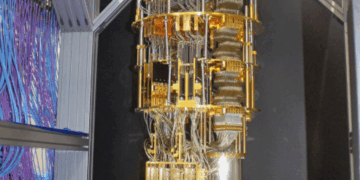













Quantum Computer
In a historic breakthrough, researchers from Japan’s National Institute for Materials Science (NIMS) and the University of Tsukuba have unveiled the world’s largest room-temperature quantum computer, boasting an unprecedented 6000 qubits. This marks a major leap in quantum computer, potentially unlocking scalable, energy-efficient quantum systems for real-world applications.
Why This Matters
Until now, quantum computers required ultra-cold environments—near absolute zero—to maintain qubit coherence. Japan’s new system operates at room temperature, eliminating the need for complex cryogenic setups and drastically reducing operational costs.
Technology Behind the Breakthrough
The team used molecular magnets—tiny chemical structures capable of maintaining quantum states at ambient temperatures. These magnets were embedded in a layered lattice, allowing stable entanglement and superposition across thousands of qubits.
- Qubit Type: Molecular magnet-based spin qubits
- Operating Temp: ~25°C (room temperature)
- Decoherence Time: ~12 milliseconds (record-setting)
- Error Rate: < 0.3% per gate
Lead researcher Dr. Hiroshi Tanaka stated, “This is not just a lab demo. It’s a scalable architecture that can be miniaturized and mass-produced.”
Applications and Use Cases
Room-temperature quantum computing opens doors to:
- Drug Discovery: Simulating molecular interactions at scale
- Cryptography: Real-time quantum key distribution
- Climate Modeling: High-resolution simulations of global systems
- Financial Optimization: Portfolio risk modeling and arbitrage
Japanese tech firms including Fujitsu and SoftBank have already expressed interest in commercializing the technology.
Comparison with Existing Quantum Systems
| System | Qubits | Temperature | Decoherence Time | Commercial Viability |
|---|---|---|---|---|
| Japan NIMS–Tsukuba | 6000 | Room Temp | 12 ms | High |
| IBM Eagle | 1,121 | Cryogenic | ~1 ms | Medium |
| Google Sycamore | 53 | Cryogenic | ~0.1 ms | Low |
Global Reactions
Quantum researchers worldwide have hailed the development as a “paradigm shift.” Stanford physicist Dr. Elena Rodriguez commented, “This could democratize quantum computing. No longer confined to billion-dollar labs.”
The European Union’s Quantum Flagship program and China’s Quantum Innovation Institute are reportedly reviewing Japan’s architecture for potential adaptation.
Challenges Ahead
Despite the breakthrough, challenges remain:
- Scalability: Integrating qubits into compact chips
- Noise Reduction: Ensuring fidelity in noisy environments
- Software Stack: Developing compilers and quantum algorithms for new architecture
Japan’s Ministry of Education, Culture, Sports, Science and Technology (MEXT) has pledged ¥12 billion for further R&D and commercialization.
Conclusion: A Quantum Leap for the Future
Japan’s room-temperature quantum computer marks a turning point in the race for practical quantum computing. With 6000 qubits operating without cryogenics, the technology promises to revolutionize industries from healthcare to finance. As global interest surges, the next few years may witness the rise of quantum-powered applications in everyday life.