











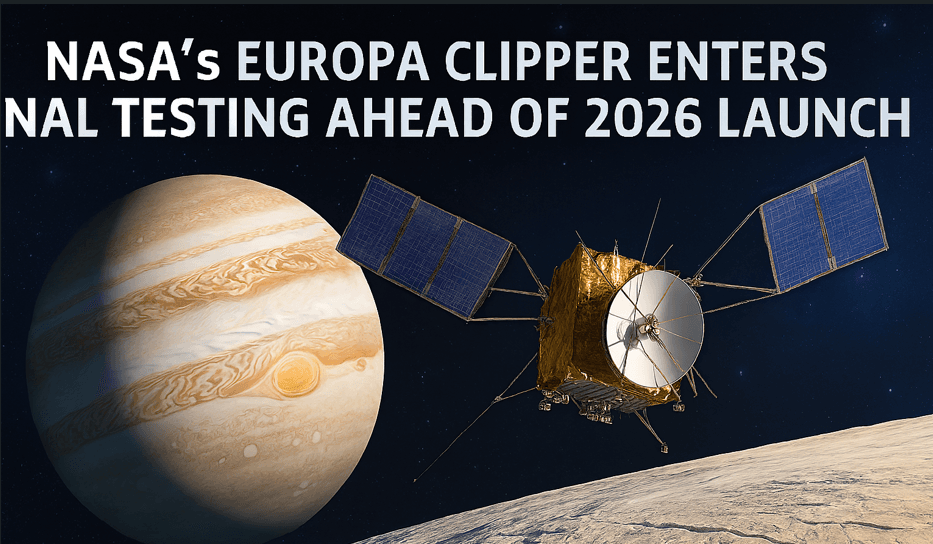
NASA’s ambitious mission to explore Jupiter’s icy moon Europa has entered its final testing phase, with the Europa Clipper spacecraft undergoing rigorous pre-launch evaluations at the Jet Propulsion Laboratory (JPL) in California. Scheduled for launch in August 2026, the mission aims to determine whether Europa harbors conditions suitable for life beneath its frozen surface.
Mission Overview
Europa Clipper is a solar-powered robotic spacecraft designed to conduct 49 close flybys of Europa while orbiting Jupiter. The spacecraft will travel over 2.9 billion kilometers and arrive in the Jupiter system by April 2030. Its primary goal is to investigate the moon’s subsurface ocean, which scientists believe may contain more water than all of Earth’s oceans combined.
Why Europa?
Europa has long intrigued astrobiologists due to its potential for hosting life. Beneath its icy crust lies a vast saltwater ocean, kept warm by tidal forces from Jupiter’s gravity. The presence of water, energy, and essential chemical ingredients makes Europa one of the most promising candidates in the search for extraterrestrial life.
Scientific Instruments Onboard
Europa Clipper carries nine science instruments and a gravity experiment. These include:
- Ice-Penetrating Radar: To map the thickness of Europa’s ice shell
- Magnetometer: To detect the depth and salinity of the subsurface ocean
- Thermal Imager: To identify warm regions that may indicate recent activity
- Spectrometers: To analyze surface composition
- High-Resolution Cameras: To capture detailed images of Europa’s terrain
All instruments will operate simultaneously during each flyby, maximizing data collection and enabling cross-validation of findings.
Recent Milestones
- August 2025: Installation of 10-foot high-gain antenna completed
- March 2025: Gravity assist maneuver near Mars successfully executed
- October 2024: Official launch from Kennedy Space Center
Engineers are now conducting vibration, thermal, and electromagnetic interference tests to ensure the spacecraft can withstand the harsh conditions of deep space and Jupiter’s intense radiation belts.
International Collaboration
Europa Clipper complements the European Space Agency’s JUICE mission, which launched in 2023 and will explore Jupiter’s moons Ganymede and Callisto. Together, these missions represent a coordinated effort to understand the habitability of icy worlds in our solar system.
Public Engagement and Legacy
NASA has invited the public to submit their names to be etched onto a microchip aboard Europa Clipper. Over 1 million names have already been collected. The mission also features a poem titled “In Praise of Mystery” by US Poet Laureate Ada Limón, symbolizing humanity’s curiosity and hope.
Potential Discoveries
Scientists hope Europa Clipper will answer key questions:
- Is Europa’s ocean in contact with the rocky mantle?
- Are there chemical energy sources that could support life?
- Do surface features indicate recent geological activity?
Even if life is not found, the mission will deepen our understanding of planetary formation, ocean worlds, and the conditions required for habitability.
Challenges Ahead
Europa’s proximity to Jupiter exposes the spacecraft to intense radiation. Engineers have built a radiation-hardened vault to protect sensitive electronics. Navigation is also complex—each flyby must be precisely timed to avoid collisions and maximize data collection.
Conclusion: A Giant Leap for Ocean Worlds
As Europa Clipper enters its final testing phase, excitement builds across the scientific community. The mission represents a bold step in humanity’s quest to understand whether life exists beyond Earth. With cutting-edge instruments, international collaboration, and public engagement, Europa Clipper is poised to unlock the secrets of one of the solar system’s most enigmatic moons.
Europa Clipper’s success could redefine our understanding of habitability beyond Earth. If the spacecraft detects organic molecules, hydrothermal activity, or signs of chemical energy sources, it would strengthen the case for life in subsurface oceans. Such findings would not only impact planetary science but also influence future missions to Saturn’s moon Enceladus and Neptune’s Triton. The data gathered could guide the design of future landers or cryobots capable of penetrating Europa’s ice shell. As space agencies worldwide increase focus on ocean worlds, Europa Clipper stands as a technological and scientific milestone in the search for life beyond our planet.




Comments 2